
It’s no longer about being qualified. It’s about being:
|
If you’re in the software / IT job market right now, here’s the truth: …..it’s not broken …but it’s not easy either! It’s the most challenging job market to i’ve seen in 20+ years of recruiting & coaching. So today I’m writing a longer blog with two major topics: |
1. The State of the Software / IT Job Market (Right Now)
The job market has improved in some areas… and remained stubbornly difficult in others. Here’s what I’m seeing consistently across engineering leaders, product leaders, IT leaders, and senior ICs:
What’s “better” right now
Hiring is happening, even if cautiously
- January – June is the main hiring season
Some sectors are loosening budgets: cybersecurity, healthcare IT, enterprise systems, infrastructure, AI-enabled product teams
Companies are moving from “freeze” to “selective hiring”
Side point: When driving in the fog you have to slow down. Similarly, with uncertainty in the economy companies slow down on decision making.
…and this directly effects hiring!
What’s still hard
Senior roles often have 200–500+ applicants in days
Many job postings are “Ghost Jobs” that companies have no intention of filling
For those “Real” job postings, companies are taking longer to decide
Interview cycles are longer and often include more stakeholders & pannel interviews
There’s heavy emphasis on:
business impact
cross-functional leadership
transformation execution
measurable outcomes
The new competitive advantage
is no longer just about being qualified.
It’s about being:
positioned clearly
easy to understand
“obvious” for the specific role
well-networked into your target companies
- a sure hiring bet
The people winning jobs right now usually have 3 things working together:
a tight narrative (LinkedIn + elevator pitch + storytelling)
a repeatable job-search system
- they approach their job search with unconventional methods that get results
Bottom line: being qualified isn’t enough anymore.
You need clear positioning + momentum + a system that doesn’t burn you out.
Which brings me to topic #2…
2. Structure Beats Motivation (Every Time)
Uncertainty messes with your head in a job search.
When you don’t know when the next lead is coming, who will respond, or what’s working, days blur together. You stay busy, but you don’t feel progress.
That’s not a motivation issue.
It’s a structure issue.
When you were working, your calendar carried you:
meetings, deadlines, priorities. In a job search, that structure disappears — and burnout shows up fast.
A job search isn’t a sprint. It’s a marathon!
So the goal isn’t “work harder.” It’s working smarter.
to stay consistent longer than everyone else.
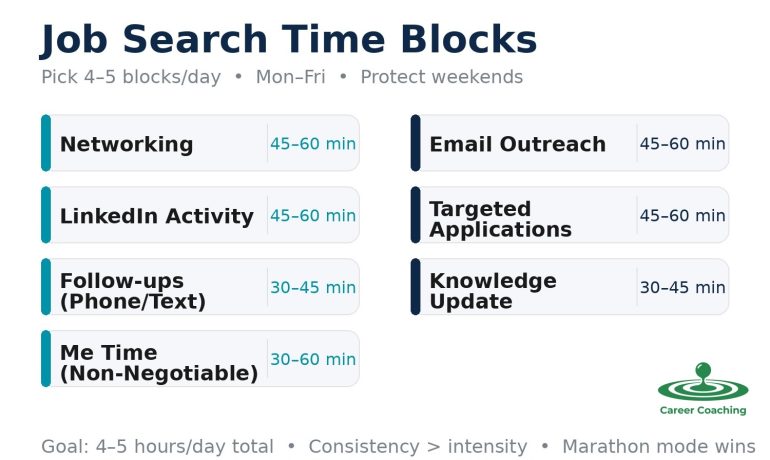
The 4–5 Hour Job Search System
Instead of treating job searching like a 7–8 hour grind (which usually backfires), I recommend this:
✅ 4–5 hours/day of focused job-search activity
✅ Monday–Friday only
✅ weekends time off (recovery is strategy)
That gives you consistency without running yourself into the ground.
TIP: The 80-15-5 rule. Most job seekers have this backwards!
Spend your time like this….
80% networking
15% talking with recruiters
5% applying online
Use 45–60 minute time blocks (pick 4–5 per day)
Choose 4–5 blocks total/day:
Networking (1:1 conversations)
Email outreach + responses
Phone follow-ups
LinkedIn (post/comment/research)
Knowledge update (stay current)
Online applications (targeted only)
And one non-negotiable:
Daily “Me Time” exercise, volunteer, hobbies, friends — whatever refuels you.
Because if you lose energy, you lose momentum.
Quick question:
What would change if your job search had a sustainable schedule behind it?